Navigating the Archive Commons for EkoFilmmaking
Online Seminar 7th May 2026 Transcript
Low-Data Low-Carbon
This transcript of a 1hr 38min session transfers under 500 kB of data. By comparison, an average webpage often exceeds 2,000 kB. If this seminar were streamed in low-compression Full HD (1080p), the data would have been approximately 2.4 GB — over 5,000 times larger. We optimise text and static assets to reduce digital carbon, resolving to stream video only when strictly necessary.
Authorship
The named authors are listed below in order of speaking during the seminar. We acknowledge both chronological and alphabetical ordering impose hierarchies on collective labour; this order is used to assist the reader in navigating the transcript’s flow.
James Price (he/him) – Filmmaker, Researcher & Educator; Founder, FfilmSchool (UK). Cultural marker: Brythonic-English.
Nurten Bayraktar (she/her) – Co-founder of EkoFilm: Sustainable Production Platform, Türkiye.
Deniz Tortum – Filmmaker, Türkiye.
Claudy Op den Kamp – Principal Academic in Film, Deputy Director CIPPM at Bournemouth University, UK.
Emily Renshaw-Smith – Executive Director, Open Planet, UK.
This transcript emerges from a dense network of relations, not solely from the five named authors. We acknowledge:
- The Participants: The live audience whose questions and interventions shaped the dialogue. Their contributions are woven into the text, though they remain anonymised here to protect privacy.
- The Intellectual Commons: The theorists, activists, and filmmakers whose work we synthesise, cite, and stand with (including but not limited to the many archivists whose labour makes “reuse” possible).
- The Material Infrastructure: This transcript was produced using Free/Libre Open Source Software (FLOSS) infrastructure. The gathering was on meet.jit.si (compromised by its use of corporate data centres) captured via OBS Studio, transcribed with Whisper (OpenAI’s tool, gleaned to run locally and independently) and edited in LibreOffice and WordPress. We acknowledge our structural coupling to extractivist grids while actively prioritising anti-extractivist infrastructure. Such work is forever in-process.
- The More-Than-Human: Energy flows and ecological systems sustain the bodies and machines involved in this exchange.
We mark this understanding in our citation by adding an ampersand at the start of the list of authors. Et al could be misconstrued.
Suggested Citation
&, James Price, Nurten Bayraktar, Deniz Tortum, Claudy op den Kamp, Emily Renshaw-Smith. “Re: Use | Navigating the Archive Commons for EkoFilmmaking.” Transcript of online seminar cohosted by FfilmSchool and EkoFilm Platform, May 7, 2026. https://ffilmschool.org/transcripts-reuse-2026-05-07/
Acknowledgements
This seminar was cohosted by FfilmSchool (UK) and EkoFilm Platform (Türkiye) made possible through funding from The British Council’s Connections Through Culture programme. We acknowledge the reciprocal labour of all participants in creating this commons resource.
License & Integrity Notice
© 2026 Authors, FfilmSchool, and EkoFilm Platform.
This work is licensed under a Creative Commons Attribution-NonCommercial-ShareAlike 4.0 International License (CC BY-NC-SA 4.0).
This transcript is a commons resource. You are free to share, adapt, translate, and redistribute it for non-commercial purposes, provided you attribute all co-authors and release any derivatives under the same license.
While we encourage circulation and adaptation, we request that you maintain the integrity and relational context of the speakers’ arguments. Please do not excerpt quotes in a way that severs them from their dialogical context or fundamentally alters their meaning. If creating an adaptation (e.g., translation, summary, or remix), please clearly label it as “Adapted from Re: Use – Navigating the Archive Commons for EkoFilmmaking” and include a link to the original full transcript.
Transcript and Slides
1. Welcome & Introduction
[Screening of https://www.vincentmoon.com/filmography/kodo/]
James: Thank you and welcome people. That was a piece of film by Vincent Moon – a wonderful filmmaker, documentarian, music aficionado who goes travelling around the world gathering bits of music being played by communities worldwide and he is a wonderful cinematographer. The reason why we’re using it for this event today is that all of Vincent’s material is released on a Creative Commons by attribution, non-commercial, share-alike basis.
Now if that’s all a foreign language to you at the moment, don’t worry! Because that’s what we’re going to talk about today with our wonderful range of panellists.
To introduce myself, I’m James Price. I’m the founder of FfilmSchool.org which uses the Cymraeg (Welsh) spelling of “film” – ffilm – and is an attempt to do documentary filmmaking differently. In a way which is responsible towards environment, society, and mental well-being.
We’ll start off with Nurten, my colleague from Ekofilm in Türkiye, who’s been absolutely instrumental in putting together today. So Nurten over to you…
Nurten: Thank you, James. Hello everybody, and welcome to the webinar. It’s very nice to see you all here today, and it is so lovely to see so many of you among us.
Today’s event is part of an ongoing collaboration between Türkiye and the UK, supported by the British Council’s Connections through Culture (CTC) Program, which supports artistic collaboration between the UK and countries in the Asia Pacific and Europe.
Our project invites everybody to rethink filmmaking in the context of the climate crisis. We focus not only on how we make films — by reducing environmental impacts — but also on transforming how filmmaking is imagined, produced, and shared. We aim to respond to what we might call the film industry’s cultural excess. Contemporary filmmaking often depends on constant production, extensive travel, and high material consumption. With the rise of digital streaming platforms over the last decade, the number of productions has been rising steadily.
Our project proposes a different approach.
We ask how we can work with what we already have. By reusing and reinterpreting archival footage, we promote low-carbon filmmaking and open new possibilities for creation that we can all share.
The project brings together the shared vision of the EkoFilm Platform, which focuses on sustainable film production and environmentally conscious storytelling, and FfilmSchool, which is committed to anti-extractivist filmmaking practices.
This is the first public event of the project. In addition to gatherings like this, we are developing guidelines for responsible archival use, producing a film using archival materials, and creating a training module. The pilot of the module will take place in Istanbul this autumn. Please follow us on social media for updates.
I would like to take a moment to thank the brilliant people who made this project possible. We are grateful to the British Council for their support — this collaboration holds special meaning for us, as I first met James through another British Council programme. James, thank you for facilitating this event and bringing together such wonderful experts. Dear Claudia and Emily, please accept my sincere compliments and thanks for joining us. And dear Deniz, one of today’s speakers — thank you for being part of the project and for being such an inspiring filmmaker. Even our shortest conversations leave me inspired and informed.
I would also like to acknowledge two wonderful people working behind the scenes. Özgür has been leading the communication strategy of the project and conducting archival research for our collaborative film — the most patient teammate award certainly goes to you. And my dear colleague Ekin, who built the EkoFilm Platform with me from the very beginning — thank you for everything we are doing together today.
2. Sustainability in the film industry
Nurten: The webinar, and the wider project, is titled Re:Use – Navigating through Archive Commons for EkoFilmmaking. When we founded the EkoFilm platform, we wanted a name that was simple yet expressive. By combining “ecological” and “film,” we coined the word Ekofilm, deliberately using the letter K in accordance with Turkish phonetics and pronouncing it as Ekofilm in Turkish. Over time, something interesting happened — people in Türkiye began using the term naturally, saying they wanted to make an ekofilm. This linguistic shift matters to us, because before sustainability becomes practice, it must first become a way of thinking.
Ekofilmmaking as a concept is not simply green production or carbon reduction — it is both a practical methodology and a philosophical position. Today, EkoFilm Platform is an NGO that provides consultancy, training, research, and resources for the film industry, primarily in Türkiye.
We are gathered here around a fundamental question: What happens when filmmaking understands itself as an ecological practice?
Our collaborative initiative with fFilm School represents a broader conceptual transformation — from extraction to care, from ownership to commons, from endless production to mindful creation. Instead of beginning with new shoots, new locations, and new material production, we invite filmmakers to begin somewhere else: with images that already exist, with collective visual memory, and with archival material circulating across institutions and communities.
Archival images allow filmmakers to move away from extraction and toward collaboration — between filmmakers, institutions, histories, communities, and audiences, just as we have gathered today. This practice also opens new creative possibilities. When we begin to see film and filmmaking as an ecosystem — where images migrate, meanings shift, and histories coexist — it also reshapes our sense of time. Rather than a linear progression from past to present to future, archival filmmaking creates a kind of temporal coexistence, allowing all possibilities to exist at once. In this way, it becomes not only a sustainable practice but also an ecological aesthetic.
In short, this project is more than an archive initiative. It is an invitation to rethink authorship, production, imagination, creativity, and originality. I am very curious to hear how our speakers will respond to this invitation. Thank you all for being here. I’ll pass the word to James.
3. Navigating the Archive Commons
James: Thank you so much, Nurten.
I’m going to go on to something which is a bit more the nitty-gritty of it all.
In every single bit of rushes that’s filmed for every single project, 90% of it perhaps, or possibly even higher, gets just left – not used at all. And there’s so much very usable footage in there which could be part of an archive commons, hugely cutting down on the expense, both financially and in carbon, of recording new material.
But we’re in a system where the privatisation of that material is at the very basis of the way in which the film industry is set up. However, film practice as a whole need not be like this. There are examples of different ways of working which are out there.
It’s a complex field, but also one which is perfectly navigable once you get the hang of it, opening up great creative opportunities in your filmmaking. I also want to acknowledge that these ‘legalities’ can be very intimidating, and we imagine lawsuits and being ruined in court. But in truth, generally the worst that can happen is being asked to take something down online, or doing a re-edit, and even that’s quite rare! If you try to do it right that’s generally enough, and really it’s just manners! Saying to someone, “I like what you’ve made here, is it ok to use it for this project?” It’s nice to be nice, and you’ll probably get another viewer for your film!
I’m going to give you a whistle-stop tour of how this landscape of re-use currently works. I’m going to introduce you to navigating the archive commons. It’s a practical workflow for finding, logging and reusing archive material: what you can reuse, where to find it, and how to attribute it both ethically and legally.
Commercial or Non-Commercial?
Your project type matters. What you can reuse is determined by the nature of your project and also to some extent how you approach the material you got from elsewhere. Commercial projects are more limited in what they can use. Non-commercial and educational projects have a much wider base of materials open to them.
The dividing line between commercial and non-commercial is not, however, that well understood. Paying the makers and contributors of your film does not make it a commercial enterprise. Essentially, commercial means profit-driven. So, a film which has been made in order to make profit. In truth, profit-driven documentary practices make up a very small amount of the docs which are being made. Estimates are that around 80 to 90% of documentaries are either grant-funded, educational, activist, or community projects, or personal and self-funded. Documentaries are not often big business.
In theory, therefore, a program which was commissioned by a public service broadcaster, like the BBC, and then only shown on those channels and not financialised further, could be considered non-commercial.
License Types
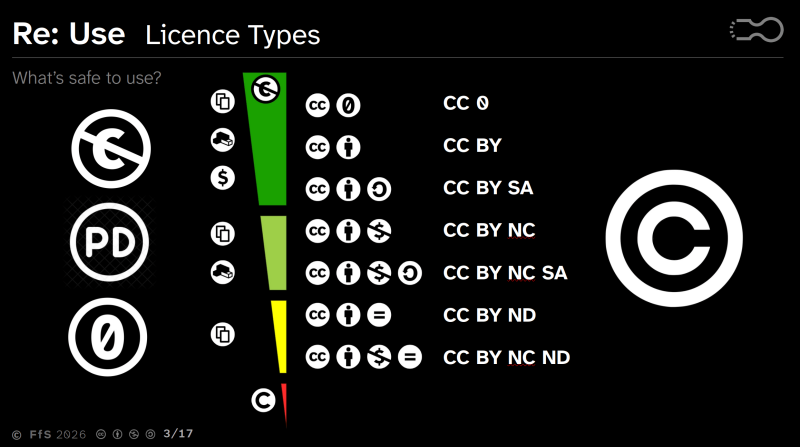
Now, look at all these logos here. It can get very confusing, all of this stuff. But basically what we’re looking at is what is safe for us to use as filmmakers. There’s a confusing array of license types available for archive material.
The least restrictive of those are on the left of the slide. You can see the copyright logo with a line through it, PD, standing for Public Domain, and CC0 there. These three symbols mean essentially the same thing for you as a filmmaker – they’re copyright-free, public domain, and Creative Commons zero. They mean that you are free to use that material however you like, both commercially and non-commercially; it doesn’t matter. Legally, you don’t even need to say who made it when you’re reusing it, although it is good practice, nice, to do so.
On the right you’ll all be familiar with the copyright symbol. This means that you can’t use it without the permission of the copyright holder, who personally or through the agents representing the copyright claim may want to charge a fee for accessing their “property”. This is except in the special case of fair use and fair dealing which Claudy will be talking about later.
In the middle here, we’ve got this sliding scale between these extremes, which are covered by the other Creative Commons (CC) licenses. These were developed 25 years ago as an alternative to the binary distinction between public domain and copyright licenses.
The little person symbol here means By Attribution (BY), which means you need to credit the authors.
This crossed-out dollar sign means Non-Commercial (NC).
This equals symbol means No Derivatives (ND). That’s important one for us to know – it is bad news for us filmmakers. It is for open distribution rather than for creative reuse purposes.
And then this kind of bendy arrow in a kind of backward C, means Share Alike (SA). This means you have to make what you’re creating available on the same basis and pass it on, essentially growing this kind of filmmaking archive.

Notice these symbols on the bottom left of the slide. You see that I’ve assigned it as a Creative Commons By Attribution Non-Commercial Share Alike (CC BY NC SA) basis. So this slideshow itself can be adapted and reproduced on that basis.
Notice also how there is a copyright symbol © at the start. It’s a misconception to think that something can’t be both copyrighted and Creative Commons. By default, what a Creative Commons licence really is saying is: “I’m the copyright holder for this work but I’m allowing it to be used in these other ways.”
We are recording today and this will also be distributed under a Creative Commons By Attribution Non-Commercial Share Alike licence.
_______
Making a Record
The important thing when you’re working is to make a record of the archive you gather. It’s something I’ll admit I find hard to have the discipline for, but it’s really important so that you can fulfill the terms of licenses for reuse, without having a big papertrail or webtrail to reconstruct at the end whch will ultimately take you much longer. Make this record as a spreadsheet as you’re going through the archives.
| Filename | Title | Creator(s) | Licence | URL / Link | ©? |
|---|---|---|---|---|---|
| Director Writer Composer Animator Prod. Co.(USA only) |
In the initial period, you want to be writing down the original Filename of the file you have downloaded, (and the given one if you have it saved as something different)
The Title, if it’s given. (With all of these things, you only have to supply it if the place the archive is from has supplied it.)
The Creator(s). That’s the legal creators of the film work. In what illustrates how we’re living in a hierarchical filmmaking culture (we’ll talk about undoing that in a future course) that is limited to: the director, the writer, the screenwriter, the composer and the animator. That’s either the animation director or it can be, in particular cases where there’s a named artist / animator who’s making the sequences it can be them as well.
And in American cases, it can be the production company. In Europe, in Türkiye, in Britain, that’s not the case, but in America, the production company can own copyright of the creative work.
It’s also important that you write down the licence – so all of those strange little acronyms. CC BY etc.
Keep a record of the URL or non-web based link if you got hold of it another way. In order to do proper attribution you need to link to the work. Most neatly and usefully, perhaps, in a QR code.
You also need to register whether it’s currently shown to be copyright ©.
When you’ve made the film you’ll need these other sections:
| Adapted? | Timecode IN | Timecode OUT | Use Case | Gratitude Notes |
|---|
It’s a licence requirement when you attribute the work, that you state whether you’ve adapted it. In 90% of cases, we will have adapted it, even if only by changing it into the format that we need it to be.
When you’re braiding the film together with your final sound and picture lock completed, make a note of the timecode in and timecode out so you can keep track of where they are in your final film.
If you’re using something which is copyrighted in the standard way you want to make note linking to the evidence of your agreement to use it, whether that was paid or free, or your case for using it as fair use / fair dealing / best efforts / public interest and so on if you haven’t got permission directly from the copyright holder.
There is usually a case for having some gratitude notes as well.
__________
Public Domain

Example: Dziga Vertov, Man with a Movie Camera, 1929.
https://archive.org/details/ChelovekskinoapparatomManWithAMovieCamera
The simplest form of copyright free is Public Domain. Public Domain is stuff which is out of copyright. So that is stuff which is old enough that the restrictions which were on it have lapsed. In the UK, Türkiye and EU that’s 70 years after the date of the death of the last of the creators of the work. And by the creators we again mean the bigwigs at the top of the hierarchy, grabbing all the glory: the director, the screenwriter, the composer of any music which is in there and the animator if there’s any animation in there.
There’s other kinds of public domain work, for example, when it’s constitutionally enshrined.
The most famous examples of these are that anything made by the United States Government is copyright free and in the public domain. And that’s actually guaranteed by the US Constitution. And as long as that is still going we can continue to use all of the US government stuff.
One beauty of this is it includes all NASA footage. Anything made by NASA is free for us to use with no restrictions whatsoever for commercial or non-commercial purposes.
Example: NASA, Armstrong and Aldrin walk on the moon, 1969.
https://airandspace.si.edu/multimedia-gallery/image/5215hjpg
__________
Creative Commons 0

There’s also a kind of Creative Commons way of making something effectively public domain: Creative Commons Zero (CC0). This means NO rights are reserved – it’s entirely waiving the right to control. This is a particularly interesting example of it: Richard Misek, The History of the World According to Getty Images, 2022.
https://www.ahistoryoftheworldaccordingtogettyimages.com
While public domain material such as very old bits of material like this one you can see here are technically public domain and free to use, companies like Getty Images, ITN, AP and Pathé use strategies like paywalls, watermarking, arranging clips in compilations and digital remastering to keep these works making money for them. You’ll probably know of digital remastering through music. It’s generally promoted to everyone as providing a “better quality” “NEW!” version but in reality I suspect it’s much more about resetting the publishing date of this material and so keeping it under copyright.
Misek Film licensed these words from Getty in order to discuss these kinds of issues and then made the high definition files available at HD resolution as an act of liberation. As you can see on the image here, this says “download film 14.7 gigabytes” so while arguably questionable from a low-data, ecological standpoint, there’s this act of liberation going on here, where this public domain material which is being held behind the paywalls at Getty have been released to people in general.
_______________
CC BY | Creative Commons by Attribution | CopyLeft
Let’s start going into the more restrictive kinds of Creative Commons licence.


The next level is Creative Commons By Attribution (CC BY) which can also be thought of as a form of “Copyleft“. In “Copyleft” material, in CC BY material, you can reuse it, change it, remix it however you like. All that’s required of you is to give an attribution (a credit) to the creators of the material. Creative Commons does have a quite strict way of giving an attribution, but again, remember that the relational effort of just trying to do right by people, will almost certainly be enough. I doubt anyone has ever been sued for not getting their attribution in the exact format the Creative Commons license demands! You can relax.
Example: Sacha Goedegebure, Big Buck Bunny, 2008.
https://peach.blender.org/download/
This is a film still from Dutch Blender Foundation who develop and distribute a free and open source software 3D animator, and made this animation to showcase the software. Because it is CC BY, both commercial and non-commercial projects can use it.
So, in reality, rather than “Copyleft” being a left wing enterprise I’d say that it’s more of a libertarian kind of licensing where both commercial and non-commercial purposes are available.
________________
CC BY NC | Non-Commercial

That brings us on to a more anti-capitalist, left wing position which resists commercial exploitation but allows Non-Commercial (NC) use. See the NC symbol here.This is stuff which is not intended for profit, such as the Vincent Moon work that I showed you at the beginning of the seminar.
Example: Vincent Moon.
https://www.vincentmoon.com/filmography
______________
SA | Share Alike

In both these forms of licensing you can have another version of it which is called Share Alike (SA). Share Alike means you need to make your film in the same way. That has real implications for a film released as a Non-Commercial Share Alike (CC BY NC SA) film which uses By Attribution Share Alike (CC BY SA) material within it (the libertarian form which allows commercial use). For you as a filmmaker or producer that means you’ll have to license those sections of your film as Creative Commons By Attribution Share Alike (CC BY SA). You can’t force a Non-Commercial restriction onto that SA material.
It you mix BY SA and BY NC SA material in your film it will complicate your credit sequence a little, but there are all kinds of creative ways that you can kind of make it a bit simpler for yourself and the viewers. These are the nuances of how we navigate making work in this way.
_______________
ND | No Derivatives

Lastly just as a short note No Derivatives (ND) is signified by this equals symbol. This is a distribution thing. It means you’re not allowed to change the film or creative work in any way. You’re allowed to show the piece wherever ydou like, but you have to show the full length of it, complete and unchanged from the copy you have. Any work which has a No Derivatives licence can’t be used for re-use filmmaking.
_____________
Open Archives
Here is a list of list of Open Archives – ones which are safe to use. There are ways of searching these archives so that you can look for things which Creative Commons or Public Domain.
Reliably safe:
NASA Image and Video Library
https://images.nasa.gov/
europeana
https://www.europeana.eu/en/search?page=1&qf=TYPE%3A%22VIDEO%22&qf=TYPE%3A%22SOUND%22&query=&reusability=restricted%2Copen
Wikimedia Commons
https://commons.wikimedia.org/wiki/Main_Page
Rijksmuseum Open Data
https://www.rijksmuseum.nl/en/collection
Yale Center for British Art
https://britishart.yale.edu/using-images
Library of Congress
https://www.loc.gov/research-centers/moving-image/collections/digital-collections/
Freesound
https://freesound.org/
FreeMusicArchivehttps://freemusicarchive.org/home
Safe (own licences):
OpenPlanet
https://www.openplanet-library.org/search
YouTube’s Audio Library
https://www.youtube.com/audiolibrary
‘Liberated’:
A History of the World According to Getty Images (see above)
Check:
Prelinger Archives
https://archive.org/details/prelinger
Internet Archive
Moving image search by Public Domain PD:
https://archive.org/details/movies?tab=collection&query=licenseurl%3Ahttp*publicdomain*
Moving image search by Creative Commons CC:
https://archive.org/details/movies?tab=collection&query=licenseurl%3Ahttp*by*
Audio search by Public Domain PD:
https://archive.org/details/audio?tab=collection&query=licenseurl%3Ahttp*publicdomain*
Audio search by Creative Commons CC:
https://archive.org/details/audio?tab=collection&query=licenseurl%3Ahttp*by*
Flickr (CC filter)
https://www.flickr.com/creativecommons/
_______________
There’s also what we might think of as Grey Archives. Within Vimeo and YouTube you’re able to search with Creative Commons filters. There is a caveat though – lots of people tag as Creative Commons things which don’t really have a Creative Commons licence on them. So just use those with caution.
Vimeo (CC filter)
https://vimeo.com/creativecommons
YouTube (CC filter)
https://support.google.com/youtube/answer/2797468?sjid=1552054692925099090-EU
________________
There’s also lots of archives which show other material which again you have to be a bit careful about reusing. Check the attribution of the licensing, and if in doubt make your best efforts to get in touch with the copyright holder for it. A word of advice, if you are getting in touch with copyright holders it’s always best to go directly to the artist, the creator themselves and not to their agents or to the production companies who made the film. Those people will almost certainly try to monetise that material, that’s their job.
The Eye https://the-eye.eu/ Out of operation since November 2025.
UbuWeb https://www.ubu.com/
Monoskop https://monoskop.org Also links to other archives.
Critical Commons http://criticalcommons.org/
PeerTube (some instances) https://peer.tube/
___________________
Lastly there’s Pirate Archives which are ones which make material available which is fully copyrighted. They’re releasing it without permission. These sites get shut down very regularly, and as a filmmaker on a re-use project I would be extremely cautious about using any of these. I’m not going to give you links to them, but it doesn’t mean that that material is necessarily impossible to use. In fact, there can be very good Fair Use / Dealing justifications for using it which Claudy will get on to later.
__________________
I think I’m going to leave it there because we have other people talking about the creative re-use, so thank you very much. I hope that was helpful
I’d like to now go on to Deniz, who is going to talk to us next.
4. Cinema of Reuse: representation of contemporary interiority
Deniz: Thank you, James. Thank you, Nurten — those were really interesting presentations, and I have quite a lot of questions.
Today I want to briefly talk about the power of reuse as an artistic angle and make one central argument for why I think it matters. I want to talk about reuse not simply as an ecological choice, or even as an aesthetic and stylistic one, but as something that has become a necessary method for representing how we actually think and understand the world today. I will argue that our inner lives — what we feel, what we know, how we conceptualize the world — are now composed of images, sounds, and digital interfaces. And a cinema that acknowledges this has to be a cinema of freedom.
I want to start with two scenes from fiction films that deal with climate change, both of which show something very real.
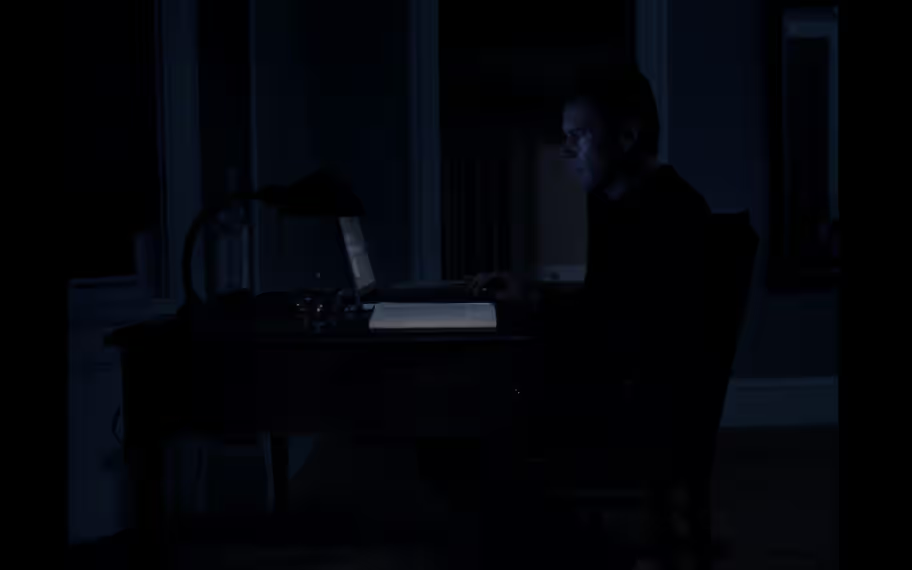
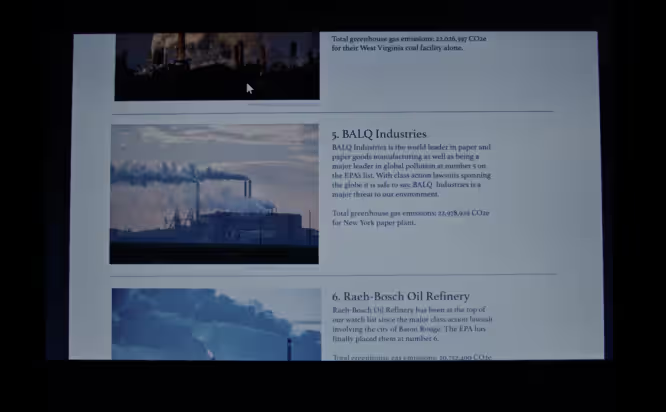
The first is from First Reformed, made in 2017. The film follows a reverend, Reverend Toller, as he becomes increasingly obsessed with the climate crisis and gradually radicalizes. In the scene I’m referring to, his moment of realization happens in front of a computer. He sits alone at night, his face lit by the screen, clicking through climate report websites and data. His radicalization unfolds through a kind of accumulation.
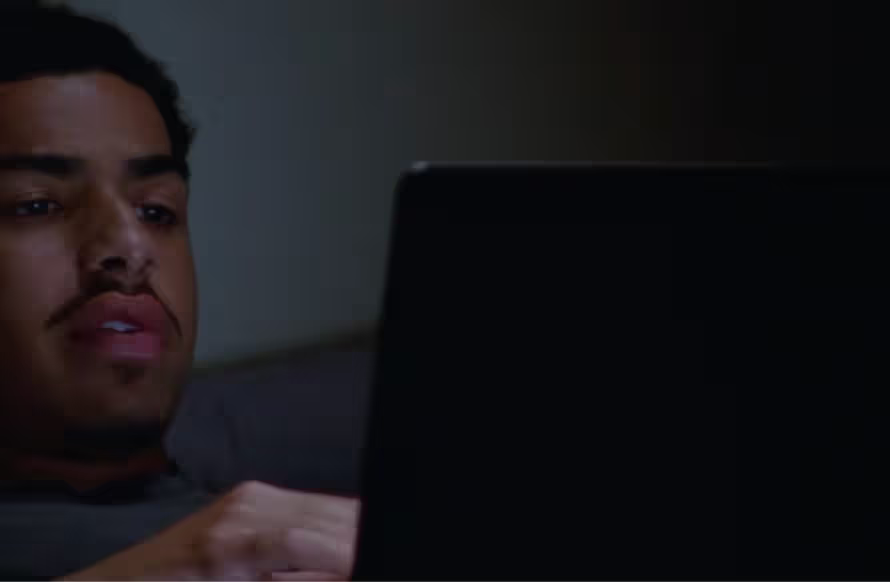
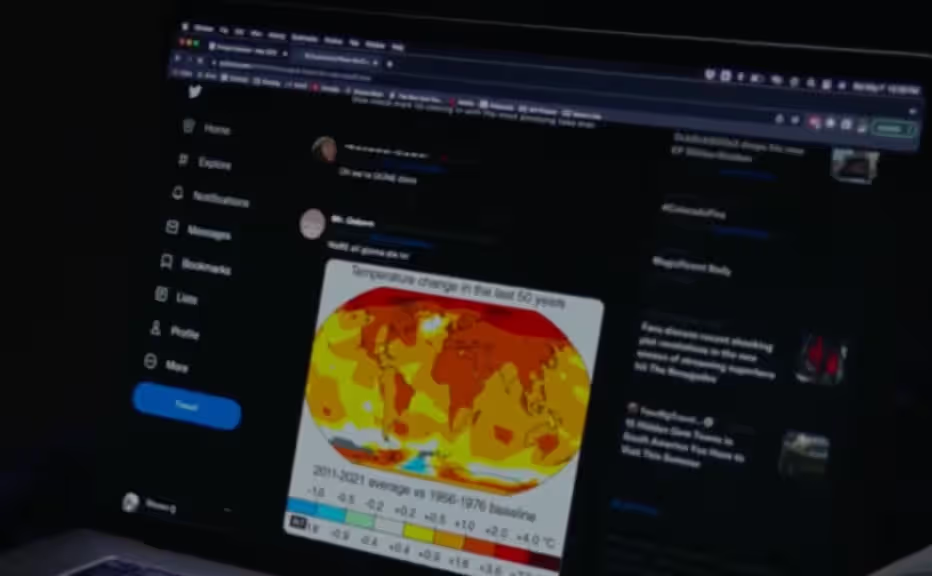
The second is from How to Blow Up a Pipeline, made in 2022, which follows a group of activists. One of the main characters, Shawn, has his encounter with the climate crisis through doomscrolling on Twitter — post after post, one following another, again with only his face visible, lit by the screen.
What is interesting about both of these characters is that they do not learn about climate change from a single moment, and they do not discover it by observing the external world around them. They don’t look outside or find it in the physical environment. They learn it — as I think I did, and as many people I know did — through repeated exposure, through fragments, through an accumulation of images and texts encountered across the internet.
Both of these are very short scenes within their films, but I think the real story lies in what happens on those screens. Because those screens are where both our interiority and, to a degree, our exteriority have migrated.
This brings me to a form I find very significant — one that has been emerging recently: the desktop film, or the screen film. This is a film form that takes the screen itself as the site of filmmaking.
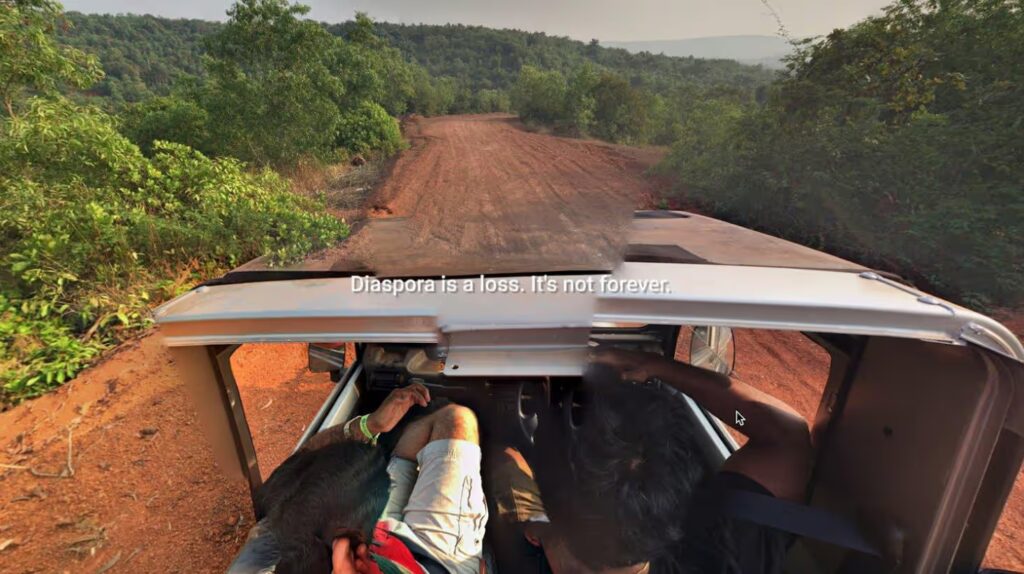
A few examples I find inspiring: But Not at Home (2019) by Suneil Sanzgiri uses digital interfaces alongside found real and virtual images, and much of his work interrogates the lasting effects of colonization.
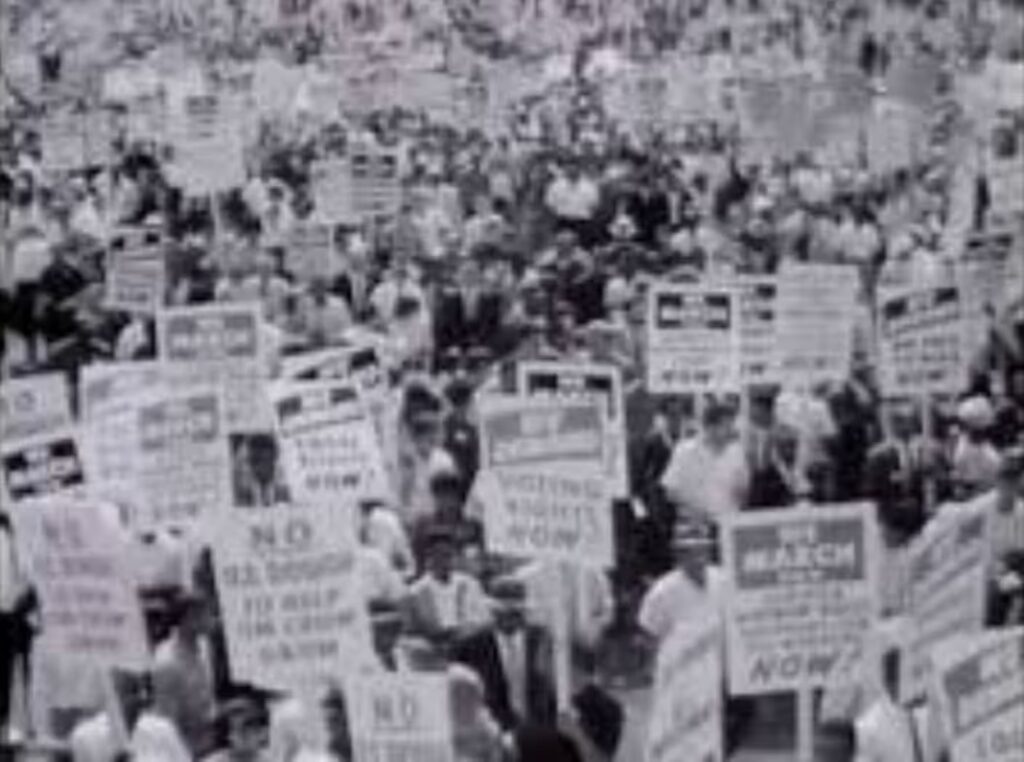
Love Is the Message, the Message Is Death (2017) by Arthur Jafa is a found footage work focused on the African-American experience and the weight of a violent history. It is not strictly a desktop film, but its editing logic closely resembles scrolling — it is almost edited in the way we encounter images online.
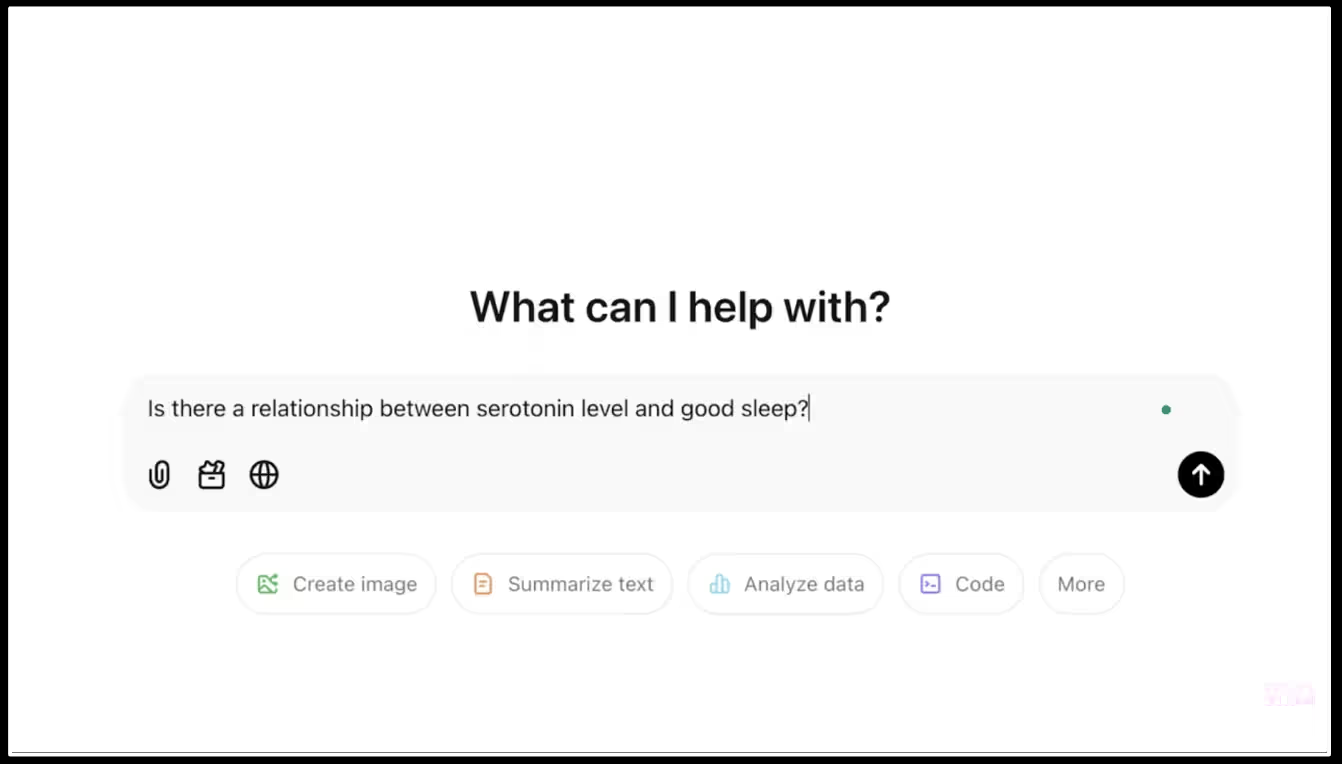
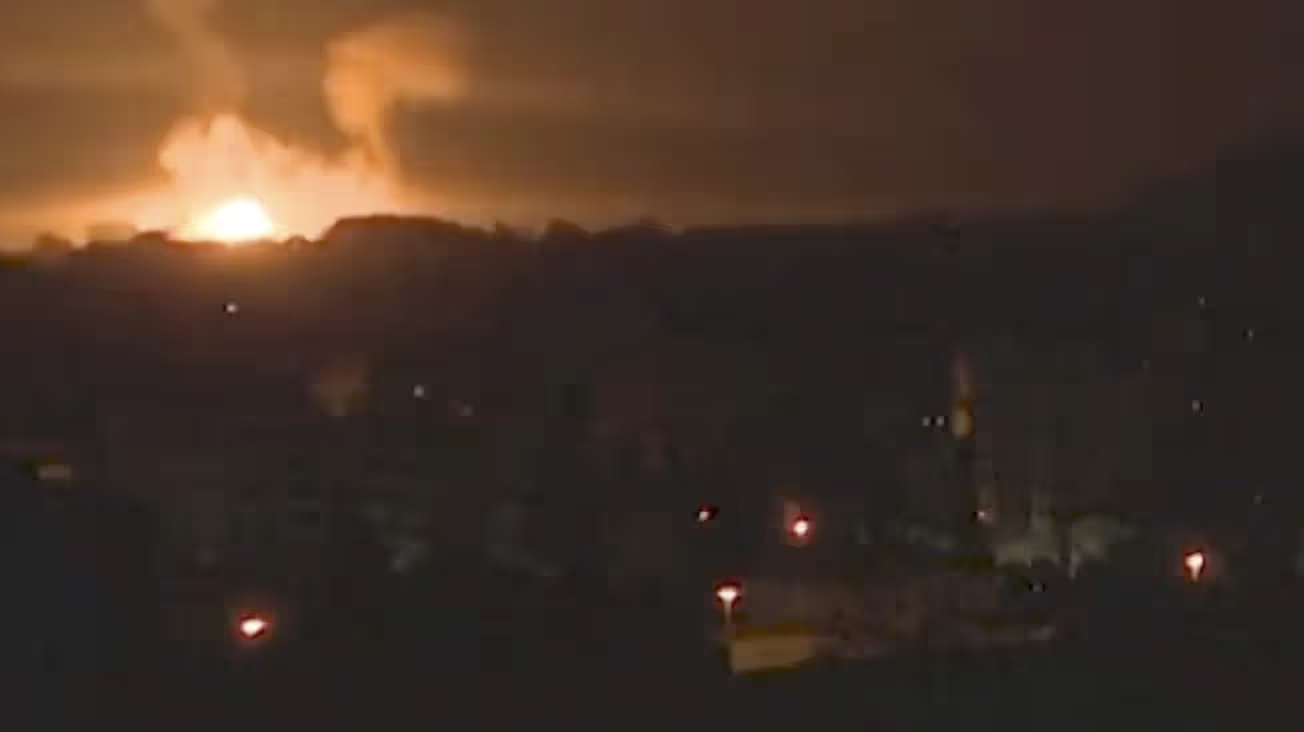
And then there is Happiness by Fran Tujaan, a very recent short film from 2025 that I find particularly inspiring. It chronicles the computer desktop diary and sleepless nights of an immigrant activist who is consumed by genocides and atrocities unfolding in real time. In the film we see social media feeds, messages between organizers, and Google searches for how to fall asleep. It is a film made mostly of recorded fragments encountered online, and it captures something I think no conventionally shot film could: the texture of political awareness as it is actually experienced today. It offers a genuinely contemporary portrait of an activist who is constantly online — and I think this mode of existence can barely be represented through any other cinematic means right now.
My broader claim, then, is that our interiority — what we think, what we feel, how we understand the world — is now constituted through images and sounds we encounter virtually. This is not mysterious, but it is different from how our inner lives were shaped before. How we navigate the world has changed. Films still represent how we wander through cities and have conversations in person, but the majority of our encounters now happen virtually, and that demands different cinematic methods.
Sensing and modelling
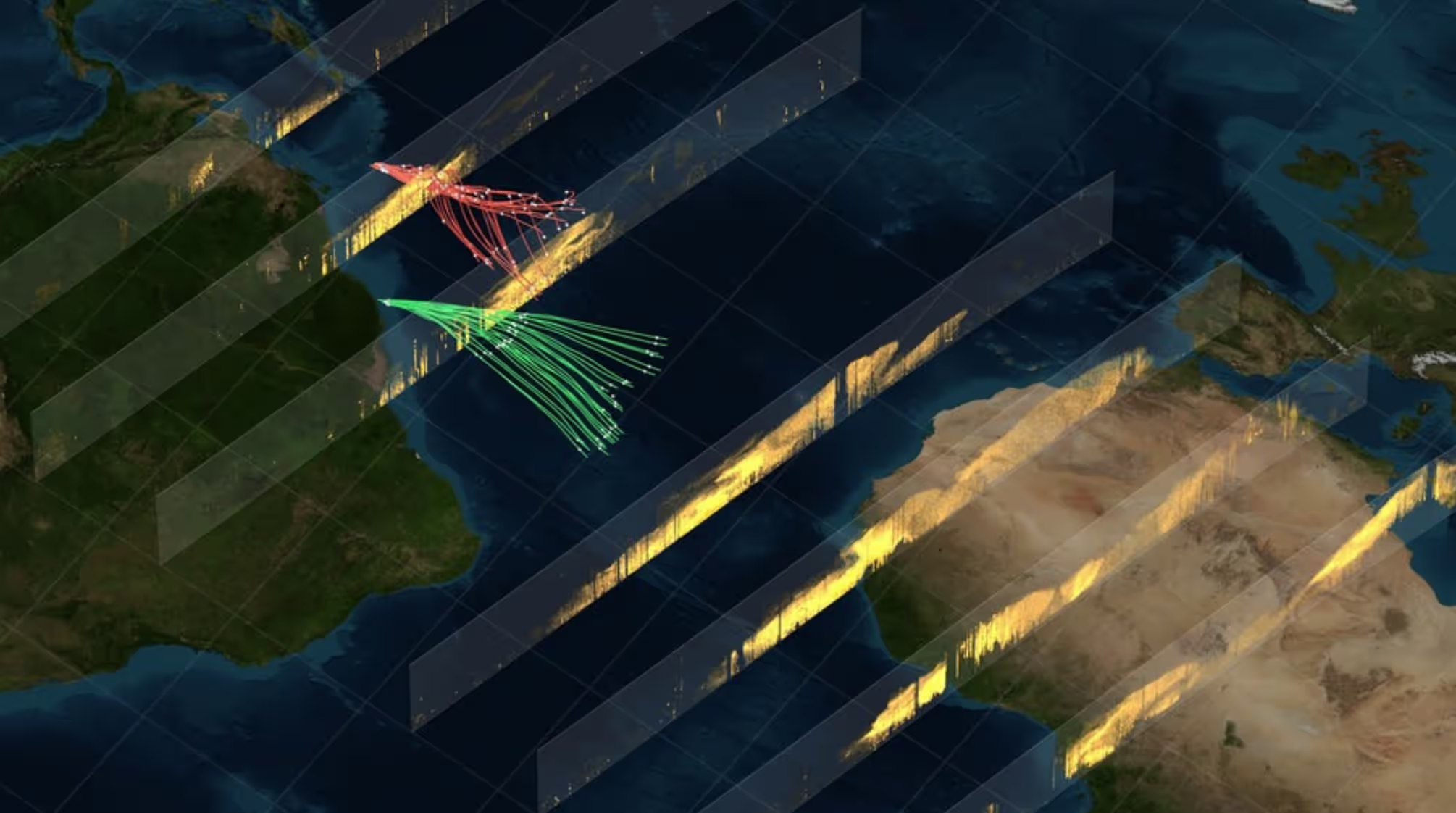
I want to end with a theoretical parallel that I think enriches this discussion. There is a fascinating paper by media theorist Mark B. N. Hansen called Media Entanglement and Hominology, in which he pushes back against Timothy Morton’s concept of hyperobjects. Morton argues that climate change is a phenomenon not fully graspable by human faculties — that it is vast, non-local, and ultimately a hyperobject beyond our comprehension. Hansen disagrees, arguing that Morton is in effect mystifying or obfuscating climate change. For Hansen, global warming is not a hyperobject — it is the conjunction of climate models, simulations, data sets, and reported weather events taken together. We can grasp and understand climate change, but only through our technologies.
I think this applies equally to how we understand the contemporary world more broadly. We understand the zeitgeist through scrolling. We understand political crisis through feeds and threads. And because of this, we need more cinema that takes seriously what happens on our screens — that treats the immediate digital image as a form of contemporary knowledge.
To summarize: we encounter the world today through screens, through the accumulation of images and sounds, through interfaces. Reuse is an ecological practice, but it is also a method of understanding how we make sense of the world.
Thank you.
James: Thank you Deniz! If we could go on to you now please Claudy.
5. Fair Dealing & Ethical Reuse
Claudy: Thank you so much this is my favourite topic of all time, so I loved listening to all the presentations and thank you for asking me to contribute. There is going to be a little overlap with what James has already said, but I think some of these things you cannot hear often enough. There is so much confusion out there. It is interesting James used Richard Misek’s film because I love his work, and I want to start with the same underlying footage.
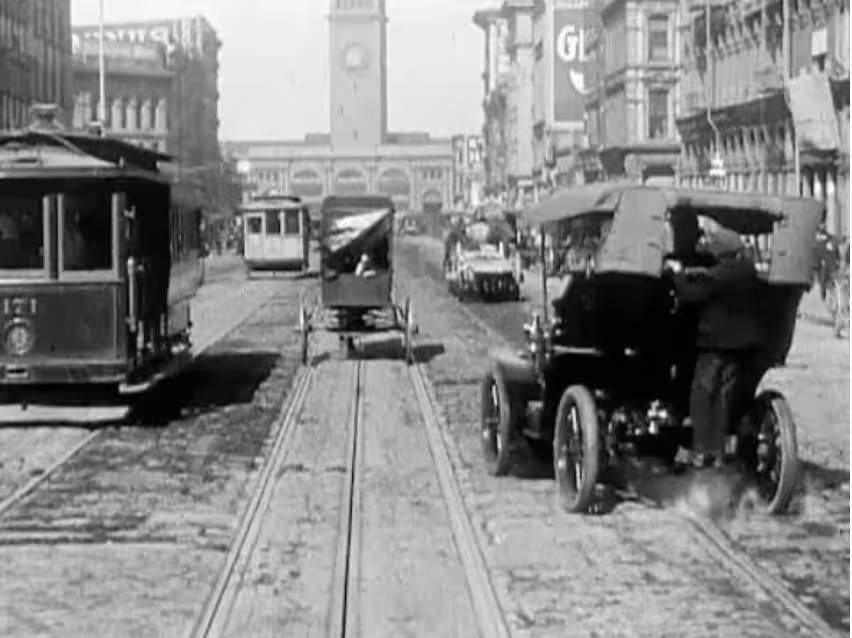
This is San Francisco 1906: a camera is mounted on the front of a streetcar and it moves down Market Street and it captured everything that it could: horse drawn carriages, early automobiles, pedestrians weaving through traffic. The city full of life.
A few days later the great earthquake hit and almost everything that you see in these frames of the film is destroyed and they are the only surviving moving image records of what San Francisco looked like before the disaster.
This film has long been free of copyright. You can download it today from the Library of Congress for free, so don’t go to Getty and pay for it!
In 1974 avantgarde filmmaker Ernie Gehr came across a copy of this film. It was through informal networks – scholar to scholar. He had friends who had a copy.
He slowed it down drastically. He stretched eight and a half minutes of film into a dream-like half hour. His film is called Eureka. It’s the name on a cart which is visible at the end of the original, but Eureka also means of course “I have found it.” It’s this beautiful pun on the original footage.
I tell you this because I think this example shows the public domain working at its best. One person’s record becomes another person’s raw material, and this document of urban life turns into a meditation on time, memory, and the fragility of images.
But that kind of re-use is rarely so easy. First of all we work with filmmakers, scholars, archivists. It’s inside a much messier landscape and that’s what I want to walk you through today: how fair dealing works; what counts as safe to use, and where the law stops being the only question of what works.
Fair Use (US) vs Fair Dealing (UK)
I want to start with the legal framework because they are not the same thing and the difference matters when you’re re-using archival material.
So in the US the rule is Fair Use. That’s a relatively open-ended system. There’s a four factor test:
- The purpose of your use.
- The nature of the original. Fiction, non-fiction.
- How much you have taken,
- The effect on the market of that original.
So a judge, because we tend to only hear about the cases that make it to court, usually takes those four factors into account. There’s no fixed list of allowed purposes which gives American filmmakers and scholars a considerable room to manoeuvrer but also considerable uncertainty.
In the UK, a quite similar but also different legal formulation called Fair Dealing exists. This is a lot narrower. You don’t argue this idea of fairness in the abstract, you have to fit your use into one of the small numbers of specific statutory exceptions.
The main ones for our purposes are these four (there are others, but these ones count most for filmmakers):
- Criticism and review.
This is straightforward documentary. You use copyrighted materials to analyse, critique, and evaluate, quoting from a film in order to discuss it. Provided you acknowledge the source. - Quotation.
This was the last one to be added, in 2014. A really, really important one. It lets you reproduce a short abstract for purposes like illustration of commentary as long as the use is fair, and the amount taken is no more than necessary. That is a vague description, but a really important one. Again the source is credited - Parody.
This lets you imitate specific works – most people recognise parody when they see it – and it usually mocks the original. - Pastiche.
This other really important one lets you imitate the style of a work or genre, or in another reading of the work, to produce something that amalgamates recognisable elements from multiple sources into something new. There something like a fan cut or a remix would be usually allowed if your clips are short enough under the pastiche exception.
Across all of those four your use has to be genuinely fair, which generally means you only take what you need, and you don’t unfairly damage the market for the original. So for instance if you have heard of the 24-hour piece The Clock by Christian Marclay, it consists of thousands of clips that deal with time, clocks and watches in film. But if you want to see, for instance, Back to the Future, you don’t go to see The Clock instead. So those markets are quite different, which is a really helpful way of thinking about it.
Students or filmmakers can get into trouble by mixing the two systems up. My students definitely use the American phrase – fair use – all the time. They assume that quoting a YouTube clip makes them safe, and they don’t argue which exception they’re actually relying on. In general we ought to nominate the exception, and then justify the fit.
There are two specific traps worth flagging. The first one is sourcing. We’ve already seen some of the websites where sourcing might not all be that lawful. Fair dealing protects you against the original copyright holder if your use qualifies. It does not immunise you for using material that was illegally uploaded somewhere in the first place. So the legitimacy of your source and the legitimacy of your use of that are two different questions.
The second trap worth mentioning is music. You can use audio that comes with a film clip. You are fair dealing, so the dialogue, the score, and the music – no matter how famous it is – is part of that clip. Only you cannot then go to an album that features that same song, lift the whole song off, put that on your timeline, edit your video to it and say, “well that song was on the score.” It doesn’t work like that. The music, the dialogue has to be attached to the clip that you are fair using.
So fair dealing is narrow, and then fair use is more rule bound, perhaps less forgiving. You have to understand which jurisdiction you are working in, and if that is the UK you need to know which exception you are claiming.
Public Domain and Creative Commons
Here I’m going to repeat a little bit what James has already said, but I think it’s important to go over the categories of materials that are, in principle, free for you to use.
As we have already seen, the Public Domain is in theory quite simple. They are usually the works whose copyright has expired. In practice it’s anything but simple. A basic rule across most countries of the World is the authors life plus seventy years. But that headline figure has a great deal of complications. So France, for instance, adds these war bonuses to compensate for the wars of the 20th century. So in France The Little Prince is still under copyright, but is free almost everywhere else. The UK gives Peter Pan a perpetual loyalty to Great Ormond Street Hospital.
Works that have already fallen into the public domain can be revived when countries change their laws. There are what one scholar has very interestingly called “copyright zombies.” The same creative work can be free in one country, protected in another. This greatly complicates the concept of public domain.
There’s also a bigger problem, which is that the term public domain historically meant two things at once. It is both “legally free” and “publicly accessible.” So for instance in the 1930s film sitting in a vault, or an unpublished library in an attic, or in my own research case of correspondence from 1893 sitting on a pallet in a library. These are technically legally in the public domain, but functionally are invisible. So the legal status doesn’t help if you cannot get to the material. So when you assess public domain status you will be asking two questions: is it legally free? But also, is it actually within reach?
Creative Commons sits in the space between full copyright and full public domain. Copyright and public domain are the ends of the spectrum. Creative Commons has been developed somewhere in the middle. It’s the set of standardised licenses that lets the creator say in advance what they are happy for you to do with their work. As we’ve already seen the cleanest is CC0, where the creator waives all their rights, effectively donating work to the public domain.
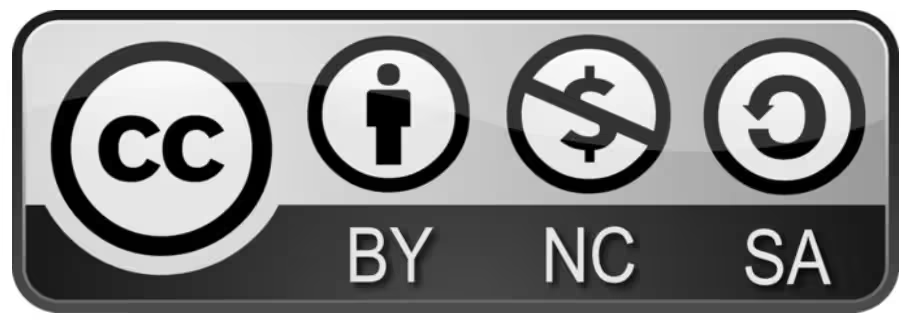
CC BY requires only attribution, so by whom it is made.
CC BY SA requires attribution and that you Share Alike your derivative work, so under the same license as the original you are using.
CC BY NC restricts you to non-commercial uses.
And CC BY ND lets you share but not modify. So the ND stands for No Derivatives.
They sort of stack. Again, there are always these caveats. Two things to keep in mind when you use Creative Commons material: first, attribution is not optional, it’s a baseline obligation under almost every CC license. I always say to my film students that respectfully crediting your sources is just a really good professional practice. Credit people where they deserve credit.
Second you have to read the license on the specific file you’re using. So in terms of music for instance, that includes the recordings separately from the composition. So while the composition may be centuries past its copyright expiring, the recording of it you’re about to put under your video, has its own copyright. And you need a recording with a license that permits what you want to do with it.
The good news is that the infrastructure for this kind of reuse is better than it has ever been. More and more institutions are releasing material on these terms. The Rijksmuseum in Amsterdam is a wonderful example. Another museum is The Yale Center for British Art. They have all of these hundreds of thousands of high-resolution images under CC0. The Library of Congress, the Internet Archive, Wikimedia Commons: between them there’s just an enormous amount of useful material.
Anti-Extractivist Approaches
I want to second the comment made at the beginning – I also find this a very difficult word to pronounce! So anti-extractivist approaches. If you say “am I legally permitted to use this” and “should I use this in this way” – these are not the same questions. This is where I want to spend the rest of my time.
The common model when we approach an archive is extractive. So when we identify what we need, we take it and put it to our own purposes, and the archive becomes this quarry. And copyright when it functions as a barrier to this extraction gets framed as the obstacle. And ethical reuse gets often reduced to this question of legal commitment. I think there are a few problems with that frame.
The first is the so-called “chaperone model.” This is a phrase from Professor of Digital Heritage Giovanna Fossati who’s now at Utrecht University in the Netherlands. Institutions often justify controlling access on the grounds that the public needs them to mediate and contextualise and interpret the material. And that justification can change quickly into paternalism; into using physical possession of those things to do what copyright no longer allows them to do – to control what legally free material people can actually see and use. Public domain is not really public if you have to ask for permission to encounter them. I feel very, very strongly about this. I’m working on a book with this topic at the moment.
The second is the so-called “fallacy of discovery”. I have huge problems with this word, when the researcher says that they “discovered” something in an archive. The word spells an assumption that the document only became meaningful when the particular person with particular questions encountered it. But of course it was already there; it was stored; it was physically present, maybe even catalogued; it already meant something to someone somewhere. This discovery framing slices the document’s existance into “before found” and “after found” – as if those are different states of the object rather than different states of the researchers’ and the culture’s awareness. That framing has done real damage to indigenous and colonial and suppressed histories, treating them as raw material waiting for this right, often Western, often institutionalised, to land on them.
And so this anti-extractivist approach starts somewhere else. It asks what relationships does this material already live inside? Whose lives, whose communities, whose labor does it represent? And what does honoring that look like beyond getting the license right?
In practice this means a few concrete things. It means treating reuse as a conversation rather than appropriation. Thinking with the material, not just about it. It means being honest about what’s missing from the archive, as well as what’s in it. Archives are not neutral. They reflect the power structures of the people who built them, and what’s absent often tells you as much as what is present. It means, where possible, working with people connected to the material rather than around them.
And increasingly it means asking ecological questions too. So reusing existing footage instead of generating new shoots is itself a form of low-carbon, anti-extractivist practice. It sort of ends as a refusal of the film industry’s culture of access.
None of this displaces the legal questions. You still need to know your fair dealing exception, you still need to read your Creative Commons license, but I kind of want to see those legal questions as the floor and not the ceiling.
Is it lawful? Is it right?
I want to draw some of these threads together. So know which legal system you’re in, Fair dealing in the UK is narrower and more law bound than fair use in the U.S., and the difference will catch you out if you don’t.
Use the public domain and create a record actively, really carefully. The public domain is messier than it looks
The CC license only covers that specific file you took it from.
And then once you clear those legal questions that keep going, then there’s the harder ones: whose history is this? What relationships is it inside? What kind of reuse honours that and what kind of reuse extracts from it?
So this expansion I’m interested in, the expansion I’d like us all to be interested in, is not to only ask “is it safe? Is it lawful?,” but also “do we think it is right?”. Those are not the same questions. I think that first one is the floor that we work from, and then that second one is about the work itself.
James: thank you very much Claudy. We really appreciate your talk. Now we’re going to go on to a very practical example of this in action, which is with Emily from Open Planet.
6. Open Planet. An Archive Commons for Ecological Impact
Emily: Thank you for having me. I’m Emily from Open Planet.
About us
At Open Planet, we’re using the power of storytelling to inspire change in this decisive decade for planetary action.
Our award-winning production studio produces groundbreaking content for impact, from landmark documentaries to immersive experiences and short-form content for influential audiences.
Our open-source footage library empowers communicators and changemakers globally to tell their own stories by accessing trusted, high-quality content for free.
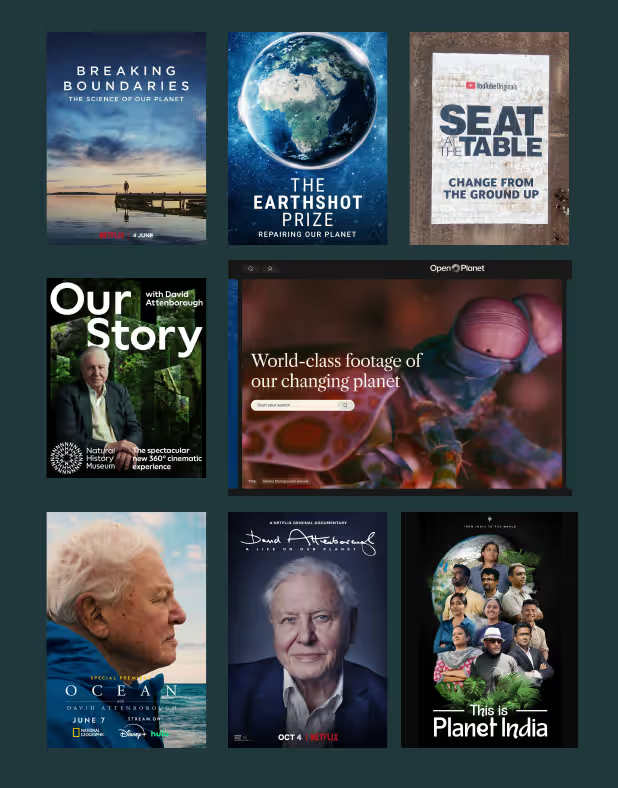
We are a production studio and also a not-for-profit video library. So we make documentaries such as Ocean with David Attenborough in co-production with Silverback Films which was released last year. We’re doing another feature documentary at the moment all about the importance of nature and biodiversity which will be out very soon. And we also do immersive experiences – we have one at the moment at the Natural History Museum all about history of humanity and the planet.
So we don’t really mind what it is that we make, but we’re very mission driven. We’re very focused on storytelling around the nature crisis and really changing hearts and minds around those issues and bringing people with us and changing the planet for the good.
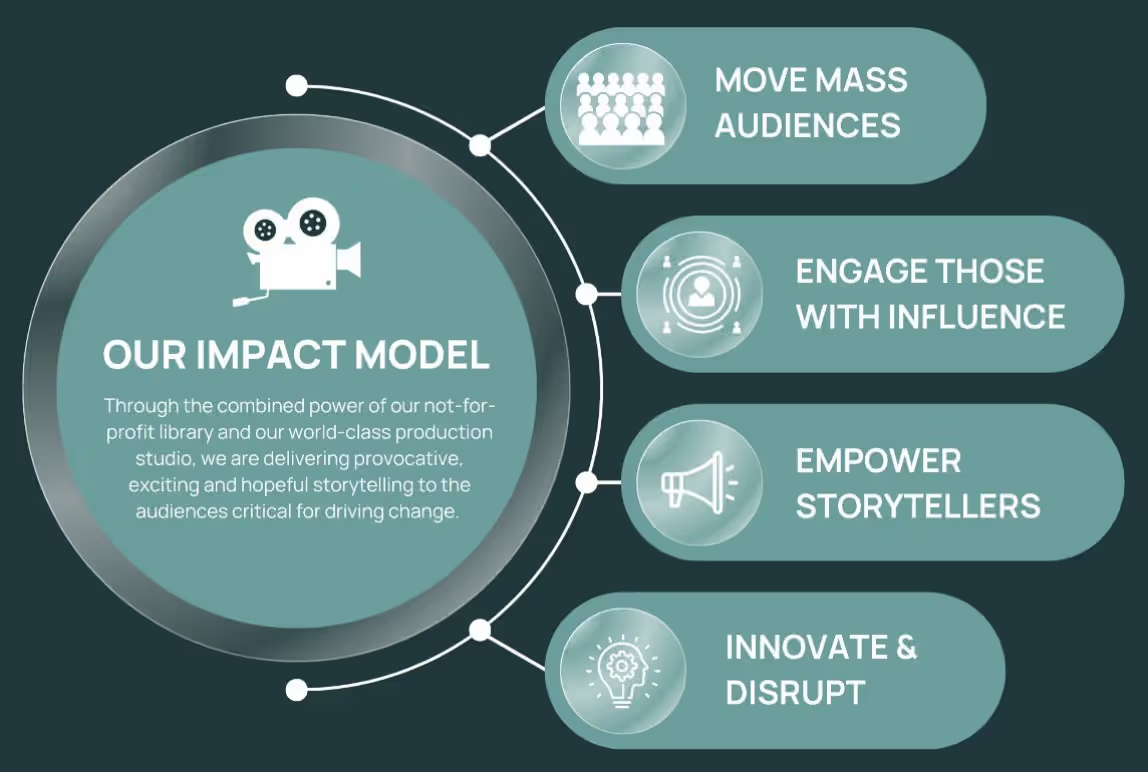
We have an impact model which is that we make the mass cultural moment as we did with Ocean with David Attenborough and share that with as many people as possible. And then we take elements from those films and really engage with those with influence. So we’ll often make some shorter cuts of that documentary and show it to world leaders or to decision makers – big international members of the COPs or the Climate Weeks and really try to influence particular policy decisions.
But then, crucially for this conversation, we open source a lot of that material onto our platform at Open Planet to empower storytellers everywhere to be able to use that content, and take it and share it with their own audiences in their own voice, in order to innovate and disrupt the models.
Our impact library
About Open Planet, our content and our impact
Our impact library was conceived of responding to market failure which is foreclosing everything that the speakers have talked about this evening.
Why Now?
| In this critical decade for action, we need to supercharge storytelling on an unprecedented scale. But storytellers face significant challenges in creating compelling, visual content about the planetary crisis: | |
| Scarcity | Footage of most of the impacts and solutions simply doesn’t exist. |
| Ownership | The high-quality footage that does is exist is nearly all rights-restricted and expensive to use. |
| Authenticity | It is often hard to authenticate what the footage shows and determine its scientific accuracy. |
| Format | Content is often in the wrong format for storytellers to easily and readily use. |
| Open Planet was created as a solution to these challenges – to revolutionise the way we tell stories about of our changing world. | |
It’s really difficult to find and access high quality video content that’s affordable to use.
So a lot of the footage of the impact of the climate and nature crisis and the solutions out there in the world either it doesn’t exist, or it’s behind a paywall, or you can’t authenticate it, you don’t know if it’s true, you can trust it. Or the format isn’t right for you to be able to use it. So we really try to solve that problem.
We have a library now of over 16,000 clips covering the beautiful footage of the natural world – our origins are in natural history programming, so a lot of the material is that type of content. But also solutions that are proposing to help with some of these issues. And we also have visualisations to help tell those stories.
So in 2025 we had over 3,000 active users in over 110 countries. We saw 26,000 downloads last year coming up to over 260 hours of footage.
It’s not just our footage from Open Planet that we contributed to the library. We have over 85 filmmakers and production companies globally who are contributing materials to that library now – all really high quality, all set to drive impact, and saving time and money and carbon for storytellers globally.
Open-sourcing impact
- Over 3k active users (8k+ indirect users) in 110+ countries, representing individual creators, educators, students, NGOs and UN agencies.
- 26k+ downloads in 2025, totalling over 260 hours of footage.
- 85+ leading filmmakers, broadcasters and production companies donating high-quality footage.
- Bespoke projects delivered to drive impactful storytelling on key issues and geographies, and to better understand storytelling needs and capabilities across different audience types.
- Saving time, money and carbon for storytellers globally.
“Our film team greatly values the Open Planet library and its mission. Access to high-quality and hard-to-obtain visuals allows us to create more powerful films for both decision makers and grassroots audiences, transforming complex environmental issues into memorable stories that inspire action.”
Sofija Korf, Film Producer and Editor,
Environmental Justice Foundation
Users of Open Planet
| Open Planet supports over 2,600 storytellers across 100+ countries worldwide. |
| Activists and community groups |
| Filmmakers and content creators |
| Multinational orgs and NGOs |
| Media and broadcasters |
| Educators |
Our users tend to fall into these categories. So, as you might imagine, lots of activists and community groups using the material we provide. Filmmakers and content creators. NGOs and multinational organisations. And educators.
| We’re filming and gathering footage across interconnected themes, including: | ||
| Natural disasters and extreme weather | Climate solutions, innovation and sustainable technology | Human health, pollution and water management |
| Deforestation, land management and food systems | Marine habitats, threats, and solutions for ocean recovery | Biodiversity, wildlife and natural habitats |
And these are some of the categories and themes that are very well served on the platform currently.
We’ve got an incredible ocean collection as you might expect, lots of climate solutions and innovation, and things covering human health, lack of biodiversity and habitats.
Our contributors
| Beyond our own shoots and productions, over 85 contributors from across the globe are currently donating footage to Open Planet for education and impact use. This includes individual cinematographers, production studios, media agencies, conservation organisations, and major broadcasters such as BBC and Netflix. Our partnerships are usually non-exclusive. Any footage submitted to the Open Planet library can be nominated for non-commercial use and/or commercial sales. |
And as I said, those contributors they really range from individual cinematographers, through to production companies like Silverback and Studio Lambert.
Ocean with David Attenborough
I think it’s worth talking a little bit about Oceans as a case study of that model that we’ve talked about.
2025 impact
- 2.2k influential VIPs and sector leaders attended the World Premiere, with a special screening to 1k young people
- Achieved box office records, showing in 1.7k cinemas across 30 countries
- Nat Geo’s most-watched Documentary/Special in 4 years
- 3.3bn reached via media/social during the launch period
- Over 160k people across 110+ countries attended free education & impact screenings – from community groups to world leaders
- Unlocked thousands of new ocean stories and campaigns via Open Planet that would have otherwise gone untold
- Australia, Greece and the UK among countries that publicly cited the film as influencing policy decisions, including the High Seas Treaty
So the film was a feature documentary. It had a premiere, a theatrical run in various countries globally and then it was released on NatGeo. And just a few months after that we released it to coincide with the UN Ocean Conference in Nice last May. It was exactly this time last year, because it was David’s 99th birthday when we premiered the film and we really aimed the film at that moment, because we wanted to influence decision makers who were voting on the ratification of the High Seas Treaty.
We’re also discussing some of the fishing practices we showcased in the film. That some of the damage that is caused by bottom trawling in the marine protected areas.
We reached an incredible number of people through the launch of the film.
“Ocean is a profoundly moving film, one that both informs and inspires. It has deepened my commitment to go beyond managing the sea — to reimagine our relationship with it. We will protect, yes. But we will also educate, collaborate, and lead.”
Kyriakos Mitsotakis, Prime Minister of Greece
“The film really helped to elevate the discussion on the High Seas Treaty and broaden it to an audience that we would have otherwise struggled to reach.”
Rebecca Hubbard, Director, High Seas Alliance
“Ocean with David Attenborough has done what years of reports could not: it shows the true devastation of bottom trawling in an instant. By making this destruction impossible to ignore, the film has helped mobilise public outrage and the political will needed to end boom trawling in marine protected areas around the world.”
Hugo Tagholm, Vice President, Oceana UK
But then we really open sourced that material onto our platform.
Powering new stories with Open Planet
- Released over 1.6k clips from Ocean with David Attenborough, curated with thousands of ocean clips from other contributors.
- Over 8.3k downloads of ocean clips between June-Dec 2025 – nearly 4.5k minutes of footage.
- Content has been used by ocean storytellers across 50+ countries: educators, activists, NGOs, filmmakers, scientists and academics.
- Stories created using ocean footage have reached hundreds of millions of people worldwide.
- Recognised by the Museum for the United Nations (UN Live) as one of the top 10 most influential cultural initiatives of 2025.
“Open Planet has gifted the world a new way of treating storytelling for the planet — as a shared, regenerative effort guided by democratisation and generosity. By opening this rare ocean footage, they’ve unleashed a global wave of storytellers, creating a sense of collective responsibility to speak up.”
Annesofie Norn, Head of Communications and Lead Curator, UN Live
So we released 1,600 clips from the material that we shot for the film onto the platform, and we saw over 8.3 thousand downloads of those clips in the second half of last year.
And the content’s being used by ocean storytellers across 50 plus countries and has reached hundreds of thousands of people worldwide which is really great to see.
We just released our impact report which there’s a link to here: https://lnkd.in/ej-3hEGq
It’s a really brilliant example of how storytelling can have a huge impact in the real world.
Working with Conservation International
Last year, our production team at Open Planet Studios teamed up with Conservation International on storytelling to help catalyse action on the 30×30 initiative — which aims to protect 30% of our oceans by 2030.
Together with inspirational rangers and local film crew, we documented stunning new visuals of seagrass restoration, coral monitoring programmes and seaweed farming at Kisite-Mpunguti National Park.
This footage is now available
Explore the full collection: https://lnkd.in/eavhvvr6
And what I’m really loving in the way that we’ve incorporated Open Planet libraries into our way of working at Open Planet Studios, is we work with quite a lot of different partners and NGOs and make films for them. But more and more now because we have a library they are agreeing to let us contribute the footage that we shoot for these projects back into the library.
For most of these projects we work with local crews. We’re not flying off our teams all over the world. But we’ll work with crews on the ground to shoot these films. We’ll use some of those camera archive in those films as B-roll and then all of that lovely material will come back into the library afterwards. So it’s creating a brilliant circular economy.
And I’d really encourage you as filmmakers to get in touch with us, and see if you can replicate that model with the work that you’re producing.
In terms of our model, we haven’t applied Creative Commons to the library. I would have really loved to be able to do that, but our licensing is just slightly more complicated. All the material at openplanet.org is available to use, for free, for impact and education storytelling. Which essentially means you can use it as well as if your use is non-commercial.
But we do also license a lot of that material commercially and at the moment, while we’re working on the next iteration of the platform, that’s a very manual process. So if you want to use any of the material in a commercial setting you can just get in touch with us and we can find what you need, and we have different rates for different uses.
But we’re really looking at the moment trying to make it much easier to figure out whether you’re usage is commercial or not, because, as I said earlier, it is a slightly grey area. Particularly if you’re posting on social media and your purpose is absolutely for having the biggest impact that you can have, you’re not intending to make any money, but you choose wrapping us around your content and so essentially it’s a commercial enterprise.
So some of these things are tricky to navigate in the world we’re in. So we’re really working on that at the moment, to try and hone, to try and make sure that as many people as possible can use the content.
I think I’m going to pause there if that’s okay.
Questions
James: Fantastic, thank you very much. As ever with these things, the time for Q&A has gone much shorter than intended! So I’d like to open it up – please if you’ve got a question go ahead and unmute yourself and ask away.
Question 1:
The intimidating nature of navigating the archive
Caitlin: I’ve got a question. So, in terms of all the information is kind of overwhelming to me because I haven’t really delved into it. And I suppose my question is if I wanted to make a documentary next year how would I go about doing it? What would you suggest? Like a specialist or an advisor, someone who knows? Because I feel like it’s – I feel for me it’s like “is it too risky for me to do that,” or what are the implications if I get something wrong? It’s just like imposing conflicts of energy to what it’s about, you know? It’s meant to be like low energy, but it takes time to educate yourself on the topic and then… you know.
James: I think you’re getting to the root of why EkoFilm and FfilmSchool decided to do something on this and hopefully the guide book – the tool kit that we’re producing should be able to help.
I think it can be very intimidating. But I think in some ways the law is what is applied. I think there’s a very important question here about “what’s the worst that could happen?” And what’s likely to happen, with a genuinely non-commercial endeavour, if you’re doing something which isn’t getting broadcasts, then really the worst that can happen is being asked to take it down or being asked to change something.
I think it’s very easy to get caught on “oh we’ve got to get this exactly right,” but ultimately (I’d love to hear from the others about whether they agree with me about this) my feeling is, if you’re trying to act ethically, and you are going ahead and using things to the best of your ability, then I think that actually that counts for a lot.
Rather than feeling like it needs to be absolutely watertight, unless something’s getting into Oscar contention, or if something’s getting onto broadcast, then those levels go up.
But I think that you probably only need that specialist advice once you get to that point.
I don’t know if anybody wants to come in on that or contest what I’ve just said?
Emily: I’m going to agree with you James, if you do get to the point where you sell your film to a broadcaster, or you’re putting it in cinemas, there will be an infrastructure there to support you. So I started my career at Channel 4, and we had a whole team of lawyers that dealt with it very carefully, going through the edit. And they’d discuss what you have in place and tell you whether the way you’re using it is okay or not, and advising accordingly.
But I think that James is right. If you’re making film and you’re sharing it over your own channels and you’ve done your due diligence as far as you can, then the risk is very low.
James: Claudy you wanted to come in as well?
Claudy: Yes thank you Emily, that’s such an excellent point, and actually something I’d like to say is that Channel 4 in my knowledge is one of the only broadcasters, if not the only broadcaster, that has their own internal fair dealing guidelines published on their website. And you can consult them https://www.channel4.com/4compliance/legal-considerations/fair-dealing-and-copyright-guidelines.
It’s a lengthy document but they are so clear in terms of the examples that are given, what the exceptions are, what would lie under that exception, what would not. And I know several filmmakers before they actually were able to afford people to check, who used those guidelines. And once they did get their final cut in front of a fair dealing lawyer who signs off on it, they only had to make minimal changes. So do look up those Channel 4 fair dealing guidelines. And they don’t only serve broadcasting, it’s also for festivals.
Some filmmakers call them a little bit conservative, but I think it’s much better to err on that side before you star pushing the regulations. Like, get a feeling for where you would cut in someone else’s material. Where you think you make your argument.
Because I think it teaches you a lot about the process of editing as well. So those guidelines are really helpful
Question 2:
What is the definition of commercial?
James: Thank you, we have another question from Lauren in the text, which says: “What is the definition of commercial? Where does making art films come into it? For example something that gets shown in a gallery and you get a screening fee, is that not commercial?”
Once again I think it comes to similar questions of what is a reasonable use of that material? And also what are the realities of the likely comeback from that material as well.
When we’re using such material in an artwork – it’s commonplace. It’s commonplace, and I think that there is a tendency when we start discussing this and getting into the complexity of it of getting very het up on the law. And perhaps forgetting that the law is really what happens in practice.
There’s actually quite a lot of stuff that happens that might not be to the letter of the law, but actually the comeback to it is very minimal. So I would like to be taking from this session today a sense of freedom with your copyright reuse rather than a sense of trepidation about what you can use and what you can’t.
Goodbye
James: I think we’re at the end of our time now.
I’d like to thank all of our speakers: Nurten, Emily, Claudia, Deniz and thank you so much to all of you for coming along, at such short notice as well. It’s been a good turn out, and I hope you’ve managed to get something out of today’s session. Thank you so much!
Nurten: Thank you everybody for being here. Please stay in touch with FfilmSchool and EkoFilm you will hear more about Re-use from us – we are preparing a toolkit, and this will be in Turkish, English and Welsh. And also we will be sharing our project film as soon as possible. We don’t know the date yet, but also we are planning to have a screening for you, piloting in Istanbul.
So please follow us as we continue through the year.